
South Africa inflation 2026 is dominating economic conversations as the country settles into the South African Reserve Bank’s (SARB) ambitious new 3% point target. After years of a 3–6% band, the SARB and National Treasury formally lowered the target in late 2025 to 3% ±1%. With February 2026 headline CPI already printing at exactly 3.0%, the big question on every investor’s mind is simple: will South Africa inflation 2026 hit the 3% target consistently throughout the year?
In this comprehensive guide, we at polymarketsa.co.za break down the latest data, key drivers, and—most importantly—how prediction markets are pricing the outcome. Whether you’re a trader, business owner, or simply want to understand where the rand and your costs are heading, this South Africa inflation 2026 analysis uses real-time crowd wisdom from Polymarket.co.za to cut through the noise.
Recent CPI Data and the Shift to a 3% Target
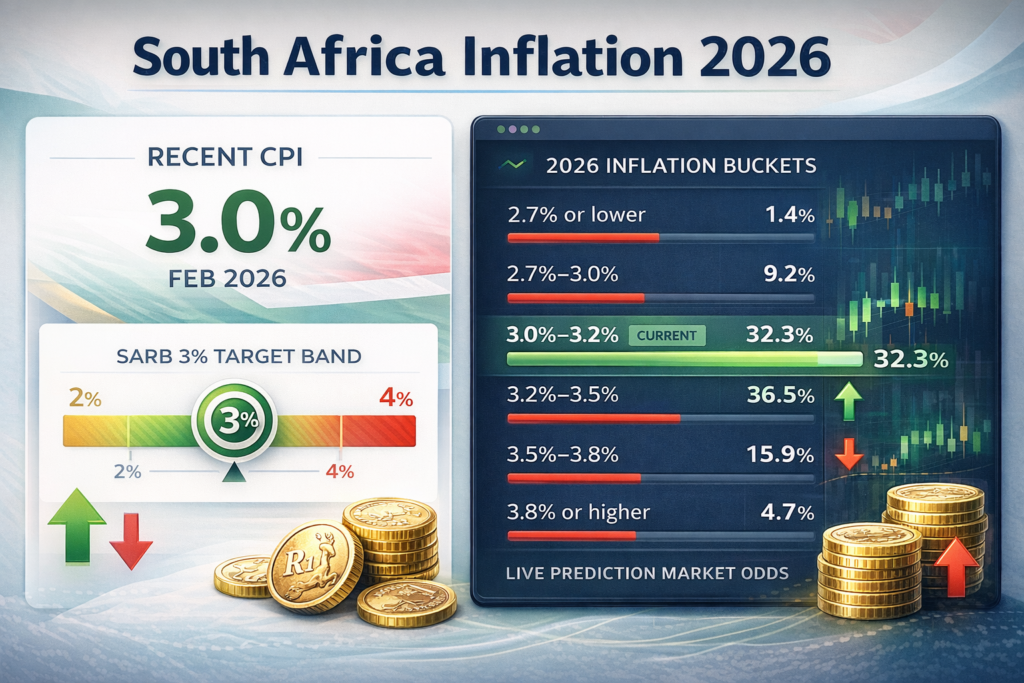
Stats SA released February 2026 figures showing annual consumer inflation cooled to 3.0% from 3.5% in January—right on the new target. Core inflation (excluding food, fuel and energy) also eased to 3.0%. The SARB’s January 2026 Monetary Policy Committee statement noted that services inflation is still slightly sticky above 4%, but the overall trajectory is “moving closer to our 3% target, as low inflation becomes the new normal for South Africa.”
The central bank now forecasts average inflation of 3.3% for 2026 (down from an earlier 3.5% projection). National Treasury and private economists are broadly aligned, expecting the figure to land between 3.2% and 3.5%. Yet volatility remains: food prices, fuel, the rand-dollar exchange rate and global supply shocks can still push South Africa inflation 2026 above or below the bullseye.
This is exactly why prediction markets have become the go-to tool for forward-looking insight.
Why Prediction Markets Are the Smart Way to Gauge South Africa Inflation 2026
Traditional economic forecasts often lag or carry institutional bias. Prediction markets like Polymarket.co.za aggregate thousands of traders who put real money behind their beliefs. The prices reflect genuine probability—updated in real time as new data drops.
Polymarket hosts a dedicated South Africa Annual Inflation 2026 market that divides the year’s average CPI into 0.3-percentage-point buckets (e.g. 3.2–3.5%, 3.5–3.8%, etc.). As of late March 2026, the market shows the highest probabilities clustered around 3.2–3.8%, with the crowd currently leaning toward the lower end of the SARB’s forecast range. These odds shift daily with every new inflation print, rand move or geopolitical headline.
Trading on South Africa inflation 2026 is straightforward:
- Buy “Yes” shares in the bucket you believe is most likely.
- If the annual average lands in that bucket when Stats SA releases the December 2026 figure (resolved early 2027), each Yes share pays $1.
- You can trade in and out anytime before resolution—no waiting until year-end.
This liquidity and transparency make Polymarket the premier platform for anyone serious about South Africa inflation 2026.
Key Drivers That Will Decide If South Africa Inflation 2026 Hits 3%
Several factors will determine whether the 3% target is achieved or breached:
- Rand Stability & Imported Inflation – A weaker rand raises the cost of imported fuel, machinery and consumer goods. Recent rand strength has helped keep South Africa inflation 2026 in check.
- Food Prices – Agriculture output, weather patterns and global grain markets heavily influence the food component (still ~15% of the CPI basket).
- Electricity & Administered Prices – Load-shedding has eased, but tariff hikes from Eskom and municipalities remain a risk.
- Global Oil & Commodity Prices – Geopolitical tensions in the Middle East or supply disruptions can spike transport costs.
- Wage Growth & Services Inflation – Services remain the sticky part. If wage settlements stay moderate and productivity rises, South Africa inflation 2026 has a strong chance of averaging close to 3%.
Prediction markets are already pricing in these risks. The current crowd consensus gives roughly a 65–70% implied probability that South Africa inflation 2026 will average inside the 3.0–3.8% range—comfortably within the SARB’s 2–4% tolerance band and very close to the 3% point target.
Risks and Opportunities for South African Investors
If South Africa inflation 2026 undershoots 3%, the SARB may cut rates more aggressively, boosting bonds, property and equities. An overshoot above 4% could force tighter policy and pressure the rand. Prediction markets let you position ahead of the curve instead of reacting after the fact.
Businesses can use these markets to lock in forward pricing for contracts or hedge input costs. Individuals can gain insight into expected cost-of-living increases well before official forecasts are revised.
Conclusion: The Crowd Is Betting on a Near-Miss—or a Bullseye?
Current prediction-market pricing suggests South Africa inflation 2026 is more likely than not to land very close to the 3% target—potentially the first full year the SARB hits its new objective. But markets can and do shift quickly. The beauty of Polymarket is that you don’t have to guess; you can participate, profit from your analysis, and let the crowd wisdom guide you.
For the most accurate, up-to-the-minute probabilities on South Africa inflation 2026, head straight to the live market on Polymarket via polymarket.co.za.